You know the moment.
- Migrants are causing the housing crisis. See how the book answers this.
- Refugees bring crime. See how the book answers this.
- I’m not racist, but … See how the book answers this.
…and suddenly everyone is very interested in the potato salad.
This book is for that moment.
‘A sharp, witty, intelligent and often heart-rending dissection of the prejudices we hold and how to dismantle them.’
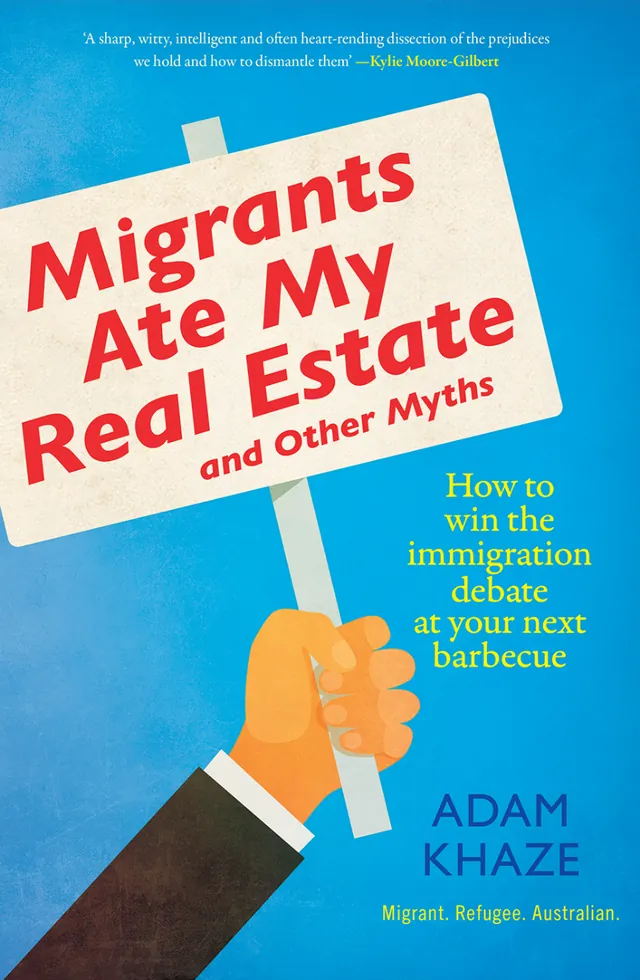
Migrants Ate My Real Estate and Other Myths
How to win the immigration debate at your next barbecue
Heard it at the barbecue?
Every myth chapter ends with a way to answer it: firm on the facts, curious about the fear, and no lecture. Pick the line you heard to see what the book suggests.
- Start with
- ‘Housing is brutal right now. People are right to be angry.’
- Then pivot
- ‘But anger still has to find the right target.’
- Ask
- ‘If migration stopped tomorrow, what new homes would that build?’
- ‘Who benefits when renters blame other renters?’
- ‘Should we be angry at people trying to get housing, or at the rules that made housing so hard to get?’
- One fact, not ten
- ‘During the border closures, migration fell sharply and housing still became more expensive. So migrants cannot be the main explanation.’
- Leave them with
- ‘Housing pain is real. The migrant explanation is not.’
Chapter 5, pages 109–110
- Start with
- ‘Migrants did not break the labour market. They are often trying to survive it.’
- Ask yourself
- Are they talking about actual unemployment or a broader feeling of insecurity and lost status?
- If wages are being undercut, who has the power: the migrant worker or the employer setting the wage?
- Would cutting migration fix the underlying problem, or would insecure work, weak bargaining and wage theft remain?
- Leave them with
- ‘If the underlying problem remains, the migrant was not the cause. They were just the easiest person to blame.’
Chapter 6, pages 137–138
- Start with
- ‘Crime has causes. Ethnicity is usually not one of them.’
- Ask yourself
- Is this claim based on the whole data set or on a single memorable incident?
- Would the offender’s ethnicity be mentioned if they were white?
- Is the proposed response likely to reduce crime or will it merely punish a community symbolically?
- Leave them with
- ‘Blaming a whole community gives us outrage but it does not give us safety.’
Chapter 7, page 171
- Start with
- ‘It’s fair to care about whether someone treats your daughter well. But it’s not fair to assume someone is dangerous because of their background.’
- Ask
- ‘Are we worried about this person’s behaviour, or are we worried about his category?’
- ‘If he were from our background and behaved the same way, would you still object?’
- If you need to be firmer
- ‘No one is stealing anyone’s daughters. Adults choose partners.’
- Leave them with
- ‘Ask whether the relationship is respectful, not whether the surname feels familiar.’
Chapter 8, pages 194–196
- Ask
- ‘Who chose this measure, and what has been left out?’
- ‘Even if a group-level statistic were true, what does it prove about this person?’
- If you need to be firmer
- ‘Using a statistic without context to cast suspicion on a whole group is not evidence-based. It is prejudice.’
- Leave them with
- ‘Data should make us more accurate, not crueller.’
Chapter 9, page 214
- Start with
- ‘They are blamed for causing housing pressure and then hired to build houses. They are blamed for crowding hospitals and then asked to staff them.’
- Ask
- ‘Who chose this measure, and what has been left out?’
- Leave them with
- ‘Migrants did not ruin Australia; they helped build it.’
Chapter 10, page 215; chapter 9, page 214; and the conclusion, page 241
- Start with firmness
- ‘No, that claim is not true, and it is not fair to blame a whole group for that problem.’
- Then curiosity
- ‘What are you actually worried about? Housing? Work? Safety? Change?’
- Before you argue, ask yourself
- Is this a pattern or a single vivid story?
- Is the blamed group easy to see, while the real causes are distant, complex or politically protected?
- Who benefits if we accept this explanation?
- If the group being blamed vanished tomorrow, would the structure causing the harm vanish with it?
- Leave them with
- ‘A messy system produces a neat villain.’
Chapter 2, pages 52–53; chapter 1, page 18; and the conclusion, page 238
Migrants built Australia.
Misinformation is tearing it down.
Adam Khaze has spent his working life inside Australia’s migration system, helping families, workers, students and employers through it lawfully. He has also heard every myth about the people who use it, on talkback radio, in comment sections and from a friend on a beachside bench.
This book takes the myths Australians hear most, about housing, jobs, crime, family and culture, and tests each one against the best available evidence. It takes the pressure underneath seriously, whether that’s rent, wages or safety, and then asks where the blame really belongs.
Along the way it traces how fear turns minorities into scapegoats, starting with his own family’s story in Iran, and digs into the long history of race science. It is funny about a serious subject, firm without being preachy, and written for anyone who has sat through that moment at a barbecue, said nothing, and wished they hadn’t.
‘The whole aim of practical politics is to keep the populace alarmed (and hence clamorous to be led to safety) by an endless series of hobgoblins, most of them imaginary.’
So who did eat the real estate?
Chapter 5 puts five suspects in the line-up. None of them needed a visa.
Scarcity by design
Rules that make it illegal, slow or financially irrational to add homes where people most want to live.
The speculative use of housing
A system that rewards holding scarce assets, so homes become wealth machines first and shelters second.
Infrastructure failure
Suburbs rezoned without the water, roads, power, sewerage, schools and transport to go with them.
Broken feasibility
Homes approved but never built, because construction, finance and approval costs make them unviable.
Political cowardice
Homeowners are organised, renters are busy surviving, and slogans are cheaper than supply.
‘Migrants are not the cause of Australia’s housing crisis. They are participants in it, victims of it and, in many cases, part of the workforce and business community who can fix it.’Page 112
Everyone knows a Bob
Bob is not his real name. He was a friend, the kind of bloke you talk with at a barbecue, with a nostalgic streak that remembered ‘summers as hotter, footy as better and parking as free’.
One afternoon, on a beachside bench on Sydney’s Northern Beaches, Adam offered his hand. Bob wouldn’t shake it. ‘You’re the reason this country’s being overrun,’ he said, and it got worse from there.
Adam hugged him. Bob pushed away and left.
Bob turns up all through the book because he isn’t a cartoon extremist. He is an ordinary man who came to believe extraordinary lies, and that makes him familiar. The book never pretends his words were acceptable. It asks how he got there, and then the harder question.
‘How do we bring him back?’
Chapter 1, page 15
What’s inside
- 1Born to Be Someone’s ScapegoatA life that began in Iran in 1985, a new start in Australia, and the afternoon a friend refused to shake Adam’s hand.p. 1
- 2The Science of Division and the Making of a MenaceWhy our brains sort people into ‘us’ and ‘them’, and how a threat becomes a legend.p. 23
- 3The Scapegoat Machine in IranHow a revolution taught neighbours to see each other as suspects, and why Australia should pay attention.p. 55
- 4How Australia Chooses MigrantsThe gate Bob imagines left swinging is really health checks, character checks, skills assessments and a great many acronyms.p. 77
- 5Migrants Ate My Real Estate!Housing pain is real. Pain is not proof.p. 97
- 6They’re Taking Our Jobs!Why economics is not ‘musical chairs with payslips’.p. 113
- 7Criminal Minds or Scapegoats?Why one offender is treated as a person and another becomes a headline about a whole community.p. 139
- 8Lock Up Your DaughtersThe oldest panic of all: that our children might fall in love with them.p. 173
- 9The Rise of ‘Scientific’ RacismFrom skull measurements to the graph someone shares in the group chat.p. 197
- 10More Than a Side Dish: How Migrants Built the Main CourseWho set the table, who cooked, and who quietly became Australian while the country argued about them.p. 215
- Conclusion: Who Gets to Belong?Firmness, curiosity, and a table wide enough for everyone.p. 235
Published by Black Inc.
Black Inc. is an independent Australian publisher and an imprint of Schwartz Books, based in Collingwood, Melbourne, on Wurundjeri Country. It publishes serious non-fiction on politics, current affairs, history and memoir, alongside fiction and poetry. Schwartz Books also publishes Quarterly Essay and Australian Foreign Affairs.
For review copies, interviews, events and rights, contact Black Inc.
- Publisher
- Black Inc., an imprint of Schwartz Books
- Published
- 2 February 2027
- Paperback
- $36.99, 288 pages, ISBN 9781760646479
- Ebook
- ISBN 9781743824993
- Category
- Society and culture
- Cover design
- Sandy Cull
- Text design
- Beau Lowenstern
This project has been assisted by the Australian Government through Creative Australia, its principal arts investment and advisory body.
Get your copy
No auction, no underquoting, no Saturday-morning bidding war.
Both go to the book’s page at Black Inc., which also links to Readings, Booktopia, Dymocks and your local bookshop.